Beat Rider: Neon Rush
- 4.2
- Rating
- 1.00M
- Installs
- Free
- Price

 Analysis by App-foxy
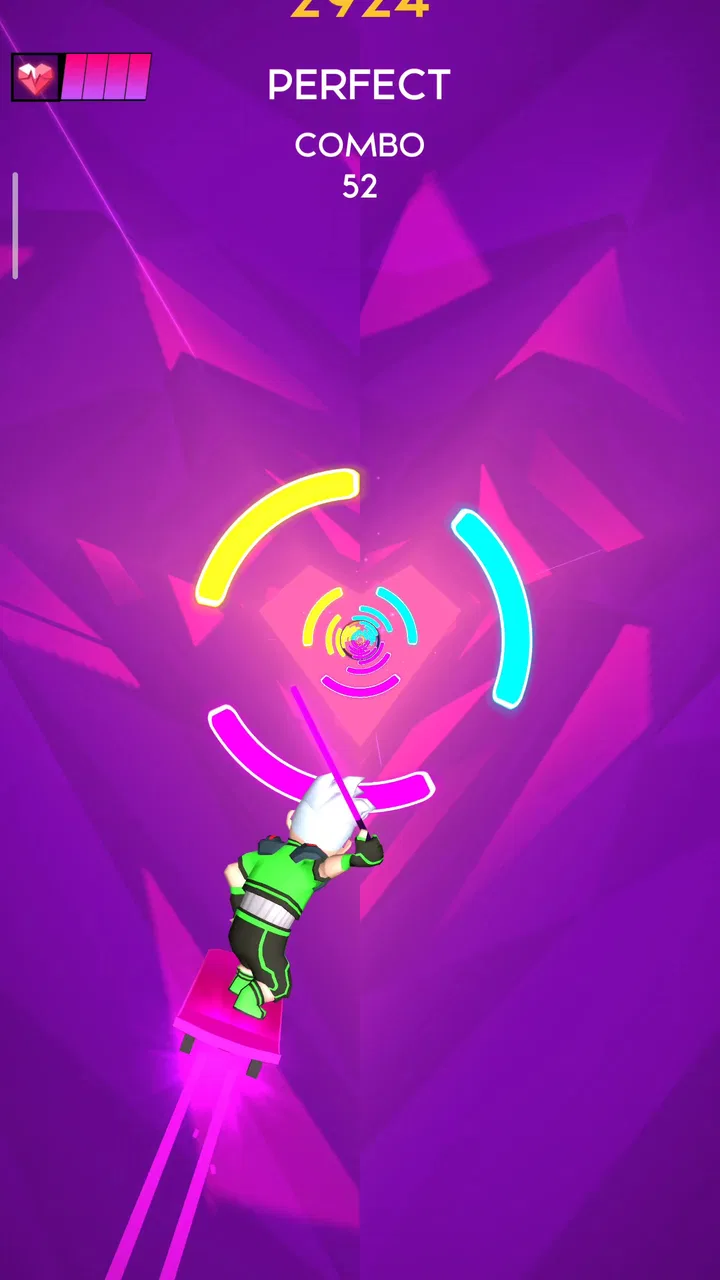
I went into Beat Rider: Neon Rush expecting a music game built around quick reactions, and that is exactly where its appeal sits: you ride a sonic skateboard, cut through beats, and try to keep your movement aligned with the track. It is a compact idea, but the combination of forward motion, music, and timing gives each attempt a clear purpose from the first tap.
This is a free music game from MayaGameStudio, available for Android devices running version 7.0 or later. It is aimed at Everyone, so the basic concept is easy to understand even if the timing becomes demanding. The game has reached over a million installs and holds a 4.2 average from around 700 ratings, which suggests that its pick-up-and-play format has found a sizeable audience.
How the ride feels from the first action
The first thing I noticed is that the game does not need a long explanation to make sense. The board moves, the music establishes the pace, and the player’s job is to react to what appears in front of the rider. That immediate relationship between sound and movement is the strongest part of the design. You are not simply watching a song play in the background; the beat gives your actions a reason to exist.
You May Also Like

 Blood Strike: 2.5 Anniversary
Blood Strike’s Loadouts Turn Every Drop Into a Tactical Gamble
A close look at Blood Strike’s custom loadouts: how fast access to signature weapons reshapes its battle royale rhythm, rewards preparation, and narrows the gap between fights.

 Pandora - Music & Podcasts
Pandora’s Music Is Easy to Start, but Harder to Recover
Pandora’s strength is its low-effort path from a seed to a station. Its weak spot is how much confidence it asks you to place in connection, setup, and quiet recovery.

 8 Ball Pool
 Is Built on Rivalries, Rematches, and Routine
A close look at the rivalries, rematches, shared routines, and unanswered safety questions that turn a quick pool match into a persistent mobile community.

 Samsung Music
’s Quiet Strength Is Playing What You Already Own
Its reach comes less from spectacle than from dependable access to a personal library. That simplicity is both the app’s strongest retention engine and its ceiling.

 AccuWeather: Weather Radar
AccuWeather Review: A Quick, Clear Forecast for Everyday Decisions
For everyday plans, the best forecast is the one you can understand quickly. AccuWeather makes rain timing, radar, and local conditions easy to act on, with a few trade-offs.

 Hill Climb Racing
Why Hill Climb Racing Still Turns Crashes Into One More Run
A tiny car, a bumpy hill and one more upgrade: Hill Climb Racing keeps resurfacing because its simple chaos makes every near-miss feel personal.
More From Our News Desk
View All News


That makes it a good choice for short sessions. I can imagine opening it while waiting for a bus, taking a few attempts during a break, or playing for longer when I want something more active than a passive music player but less involved than a full action game. The central idea is readable within moments, which is important for a title that depends on rhythm rather than a complicated control scheme.
The skateboard theme also gives the game a more physical identity than a standard tap-to-the-music experience. The sense of riding forward creates anticipation: every upcoming beat feels like part of a route, not just an isolated prompt. That forward pressure is what encourages another attempt after a mistake. I want to see whether I can stay in control for a little longer, especially when I feel that the failure came from one late or early reaction rather than a complete loss of understanding.
The best way to approach the opening is to treat the first few runs as calibration. Instead of chasing a perfect result immediately, I pay attention to the relationship between the visual cue, the sound, and the moment when the input needs to happen. Rhythm games often feel easier once the player stops reacting only to graphics and starts anticipating the musical pattern. That is a useful habit here because the soundtrack is not decoration; it is part of the control language.
Reading the feedback instead of guessing
A rhythm game lives or dies by feedback. When I make a successful move, I need to understand instantly that it worked. When I miss, I need enough information to adjust rather than simply blame the game. Beat Rider: Neon Rush works best when I focus on that exchange: cue, reaction, result, and correction.
The sonic skateboard concept naturally supports this rhythm. A successful sequence feels like maintaining a line through the music, while an error interrupts the flow and reminds me that timing matters more than frantic tapping. That distinction is useful for new players. Random inputs may occasionally get through an easy passage, but they are not a substitute for learning the beat. The game rewards attention more than button mashing.
For anyone struggling at first, I would recommend using a consistent hand position and making smaller, deliberate inputs. Changing grip or moving the phone around can make timing feel less reliable, especially during a fast section. I also find it helpful to listen for the repeated pulse before trying to react to every visual detail. The screen tells me what is coming, but the music helps me decide when to commit.
One practical trade-off is that a rhythm game can feel very different depending on the player’s surroundings. In a quiet room, the audio can guide the session naturally. In a noisy place, visual concentration becomes more important, and the experience may lose some of its musical character. If I were playing outside or in a busy waiting area, I would keep expectations modest and use shorter runs rather than judging the whole game from a distracted attempt.
The game is also more suitable for players who enjoy repetition than for people seeking a story-driven music adventure. Its satisfaction comes from refining a run, not from uncovering a large narrative or managing a deep collection of characters. That is not a flaw in itself, but it defines the audience. If I wanted a long campaign with dialogue, exploration, or role-playing systems, I would choose a different kind of mobile game.
Why a successful run feels rewarding
The reward here is mainly performance-based. I get satisfaction from keeping the ride going, matching the action to the beat, and turning a previous mistake into a cleaner sequence. That may sound simple, but it is the same reason many good arcade games remain compelling: the objective is visible, the failure is immediate, and improvement can be felt without needing a tutorial to explain it.
I especially like the point at which a difficult section starts to become familiar. At first, I react too late because I am waiting for the cue to become obvious. After several attempts, I begin to recognize the lead-in and prepare earlier. The reward is not only a better result; it is the feeling that the music and the controls are finally lining up in my head.
This makes the game useful for players who enjoy measurable personal progress, even when they are not competing with anyone else. A short session can have a simple target: survive one more sequence, improve the timing of a particular passage, or finish a run with fewer mistakes. Those small goals keep the experience from becoming an empty loop.
There is also a nice difference between playing casually and playing with intent. A casual run is something I can start without preparation, while a focused run asks me to listen closely and avoid distractions. The same basic mechanics support both moods. That flexibility is one of the reasons the free format works well: I do not need to reserve a large block of time to get something from it.
Still, the reward structure will not satisfy everyone. Players who need constant unlocks, extensive customization, or a strong sense of long-term progression may find the core loop too narrow. Music games can be deeply replayable, but replayability depends on whether the player enjoys mastering timing. If that kind of self-improvement does not appeal to you, the ride may feel repetitive sooner than it would in a more content-heavy game.
The reset after a miss
Failure is a central part of this kind of game, so the reset needs to feel like an invitation rather than a punishment. In my experience, the most convincing reason to restart is that the previous run leaves a clear lesson behind. I know where my timing slipped, and I want to test the adjustment immediately while the pattern is still fresh.
That quick mental reset is important. If I spend too much time thinking about a mistake, the energy of the session disappears. Beat Rider: Neon Rush benefits from keeping the objective straightforward: ride, react, recover when possible, and try again. The simplicity makes the restart feel natural, particularly when I believe the miss was within reach of correction.
My main advice is not to restart automatically after every imperfect moment. A run with one mistake can still teach more than a rushed restart, because it lets me observe what happens after the error. Staying calm also helps reveal whether the problem was one bad input or a broader issue with reading the sequence. That is a small but useful distinction for improving efficiently.
The reset loop is less appealing when I am tired or when the audio is difficult to hear. Rhythm games demand a certain level of attention, and repeated attempts can become frustrating if I am playing without the conditions needed to read the beat. In those moments, another game with slower pacing may be a better choice. The title is at its best when I have enough focus to turn a failed run into information.
Because the game is free, it is easy to try without committing money at the start. There are in-app purchases ranging from under a dollar to around twenty dollars per item, so I would approach those options carefully and decide whether the basic loop already gives me enough enjoyment before spending anything. The free entry point is helpful, but the presence of purchases means it is worth keeping an eye on the buying process, particularly on a shared device.
Where it fits among mobile music games
Compared with a conventional rhythm game that keeps the player stationary while notes travel toward a target line, this one has a stronger sense of movement because the rider is progressing through a sonic route. That makes the action feel more like an arcade ride than a pure timing exercise. The difference is small in concept but meaningful in practice: I am not only matching notes; I am trying to preserve momentum.
On the other hand, players who prefer the precision and visual clarity of a traditional note-lane game may find the skateboard presentation less direct. A lane-based alternative can be better when I want to concentrate exclusively on exact timing without the extra feeling of steering through a world. Beat Rider: Neon Rush is the better fit when the fantasy of riding with the music adds motivation.
It also occupies a different space from music games built around composing, mixing, or collecting songs. I am not opening it to create a track or manage a virtual music library. I am opening it to play through the rhythm. That focus keeps the controls approachable, but it also means the game’s value depends heavily on how much I enjoy repeating action sequences.
For younger players, the Everyone rating makes the premise approachable, and the controls are easy to explain in ordinary language: follow the beat and handle what appears on the ride. Adults can enjoy it for the same reason, especially when they want a quick arcade distraction. Parents should still remember that free games with optional purchases deserve the same spending awareness as any other mobile title.
Device compatibility is another practical point. The minimum requirement of Android 7.0 makes it accessible to many older phones, though compatibility alone does not guarantee that every device will feel equally comfortable for fast timing. Screen responsiveness, audio delay, and the physical size of the phone can all affect the experience. If the rhythm seems consistently late, I would first check my surroundings and the device’s audio behavior before deciding that my reactions are the problem.
Small habits that make the loop more enjoyable
I get better results when I start with a listening pass instead of treating the first attempt as a test of reflexes. I pay attention to the repeating pulse, notice how the visual cues arrive in relation to it, and then make the next run more deliberate. This turns the game from a sequence of surprises into something I can gradually predict.
A second useful habit is to separate accuracy from speed. When a section becomes busy, my instinct is to move faster, but frantic inputs often make the timing worse. I try to keep the same controlled rhythm and let the game’s pacing dictate my actions. The goal is not to look busy; it is to be correct at the right moment.
I also recommend using a short-session rule when frustration starts to build. Three focused attempts can be more useful than ten careless ones. After a few misses, I take a break and return later, because the reset loop stops being rewarding when I am repeating the same mistake without listening. This approach preserves the game’s strongest quality: the sense that another run might genuinely improve on the last.
For a realistic everyday scenario, imagine having ten minutes before an appointment. I would play one or two runs with the sound at a comfortable level, set a small goal such as reaching a familiar section more cleanly, and stop once my attention begins to drift. That is where the game feels most natural. It does not demand a large commitment, yet it gives the short session a clear beginning, challenge, and conclusion.
Who should play and who should pass
I would recommend it to anyone who likes music games with an arcade edge, especially players who enjoy learning patterns through repetition. It is also a good match for people who want a game that can be understood quickly but still offers room to improve timing. The skateboard theme gives the familiar rhythm formula a more active personality.
I would be more cautious about recommending it to someone who wants a deep story, social competition, creative music tools, or a large strategic system. Those expectations point toward different genres. I would also skip it if I strongly dislike replaying the same sections after a mistake, because the reset is not a side activity here; it is the engine of the experience.
The purchase model is another reason to play with a little awareness. The game costs nothing to start, which makes trying it straightforward, but optional items can reach a noticeable price. I would first decide whether the free experience already earns regular play, then treat purchases as a personal choice rather than something required to understand the basic appeal.
Since the game was released on January 22, 2025, and the current version is 1.3.3, the version number is worth checking when troubleshooting or comparing the experience across devices. I would also keep expectations realistic about what a compact music game can provide: its strength is the immediate loop, not a promise of a broad, multi-genre adventure.
My verdict on the ride, reward, and restart
Beat Rider: Neon Rush succeeds when its pieces stay connected. The action gives the music a physical purpose, the feedback shows whether my timing is working, the reward comes from extending and improving a run, and the reset gives me a reason to try again while the lesson is still clear. That is a clean loop, and it is specific enough to make a short mobile session feel worthwhile.
Its limitations are equally clear. The experience can become repetitive for players who need constant novelty, and it asks for genuine concentration when the rhythm becomes harder to read. Optional purchases mean I would also play with spending awareness. None of those points cancel the core appeal, but they do define when the game is a good fit.
After trying it, I see it as a strong choice for quick rhythm-focused play rather than a complete music platform. MayaGameStudio has built the appeal around the moment-to-moment ride, and that is where I would judge it. If matching beats while controlling a neon-styled skateboard sounds satisfying, the free download is easy to justify. If you want a campaign, composition tools, or a game that rewards exploration more than repetition, I would look elsewhere.
My final recommendation is simple: give it a focused first session with sound available, learn the timing instead of tapping randomly, and judge the game by whether each restart teaches you something. When that feedback loop clicks, Beat Rider: Neon Rush becomes the kind of small game I can return to for one more run without needing a complicated reason.
FAQs for Beat Rider: Neon Rush
01What kind of game is Beat Rider: Neon Rush?
Beat Rider: Neon Rush is a rhythm-based game where players navigate through neon-lit tracks by tapping and swiping in sync with the music. The game offers a unique blend of fast-paced action and musical immersion, featuring various difficulty levels to cater to both casual players and rhythm game enthusiasts.
02Is Beat Rider: Neon Rush free to play?
Yes, Beat Rider: Neon Rush is free to download and play. However, it includes in-app purchases and ads to enhance the gaming experience. Players can opt to purchase additional tracks, customization options, or remove ads for a more seamless experience.
03What are the device requirements for Beat Rider: Neon Rush?
Beat Rider: Neon Rush requires Android 5.0 or iOS 10.0 and above to ensure smooth gameplay. It is recommended to have at least 1GB of free storage space and a stable internet connection for downloading additional content and updates.
04Can I play Beat Rider: Neon Rush offline?
While Beat Rider: Neon Rush can be played offline, some features such as purchasing additional tracks, accessing leaderboards, and receiving updates require an internet connection. Playing online also enhances the experience with social features and competitive play.
05Does Beat Rider: Neon Rush offer multiplayer features?
Yes, Beat Rider: Neon Rush includes multiplayer features, allowing players to compete against friends or global players. You can connect via social media or invite friends directly to challenge each other, adding a competitive edge to the rhythm-based gameplay.
Pros
- Vibrant and engaging neon graphics.
- Intuitive controls suitable for all ages.
- Wide variety of music tracks to choose.
- Regular updates with new content.
- Offline mode available for play anywhere.
Cons
- Occasional in-app ads can be distracting.
- Some premium features require payment.
- Limited customization options for avatars.
- Initial load time can be slightly long.
- Requires significant storage space.

Beat Rider: Neon Rush
Gallery